
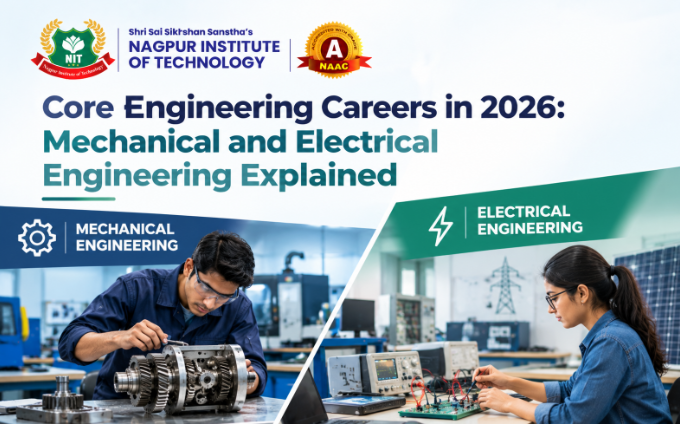

Mechanical and Electrical Engineering are sometimes described as “old” branches because they existed long before today’s software-led courses. That description misses what is happening in industry. Electric mobility, renewable energy, automation, advanced manufacturing, robotics, energy efficiency and smart infrastructure still depend on mechanical and electrical systems; the tools around them are becoming more digital.
A student deciding between these branches should therefore ask a practical question: what kind of physical systems do I want to understand and work with?
Mechanical Engineering is broader than machines in a workshop
Students considering a mechanical engineering college in Nagpur will normally study mechanics, engineering drawing, materials, manufacturing, thermodynamics, fluid mechanics, heat transfer, machine design and production-related subjects. Computer-aided design, simulation, mechatronics, automation and quality systems increasingly sit alongside these foundations.
Mechanical careers can appear in manufacturing, automotive systems, HVAC, energy, industrial equipment, product design, maintenance, quality, production planning and project engineering. The exact role depends heavily on practical competence. Being able to explain a drawing, measurement, process, tolerance, material choice or design calculation is more valuable than memorising definitions for an interview.
AICTE’s model curriculum for Mechanical Engineering stresses outcome-based learning, industry relevance, hands-on experience and internships. That is a useful benchmark when comparing colleges. Ask whether students use design and simulation software, whether students actually use workshop equipment, and whether final-year projects solve a real engineering problem.
Electrical Engineering sits at the centre of electrification
An electrical engineering college in Nagpur should prepare students in circuits, electrical machines, power systems, measurements, control systems, power electronics and related laboratory work. Modern applications extend into renewable energy, electric vehicles, industrial automation, drives, smart grids, embedded control and energy management.
India’s renewable-energy build-out gives this field a clear practical context. The Ministry of New and Renewable Energy reported 168.04 GW of cumulative solar capacity and 58.52 GW of wind capacity as of 31 August 2026. Those numbers do not guarantee jobs for every graduate, but they show the scale of electrical infrastructure being built, operated and integrated with the grid.
Electrical students should therefore look beyond textbook circuit solving. Ask whether the programme connects theory to machines, protection, power electronics, renewable systems, industrial controls and safety.
Which branch has better job prospects?
There is no honest universal answer. Hiring changes by region, economic cycle and sector. A mechanical graduate with strong CAD, manufacturing and problem-solving skills can outperform a weak student from a supposedly “hotter” branch. The same is true in electrical engineering.
Instead of predicting the job market four years in advance, compare the skill stack each branch allows you to build.
Mechanical students can combine core knowledge with CAD/CAE, CNC, automation, industrial engineering, data analysis or mechatronics. Electrical students can add PLC programming, power electronics, renewable-energy systems, embedded systems, industrial automation or basic programming. These combinations make traditional branches more adaptable without abandoning fundamentals.
Laboratories should influence your college choice
Core engineering cannot be learned only through slides. Visit laboratories and ask what students actually do there. In Mechanical Engineering, look for measurement, manufacturing, thermal, fluid, design and workshop exposure. In Electrical Engineering, check machines, circuits, measurements, power electronics, control and simulation facilities.
Working equipment is only one part of the test. Ask how many students share an experiment, whether students take readings themselves, how lab performance is assessed and whether equipment is available for project work. A laboratory that exists for inspection but is rarely used has limited educational value.
Internships matter because the workplace is different from the classroom
A factory floor, power installation, design office or maintenance site introduces constraints that textbooks cannot reproduce: safety procedures, deadlines, tolerances, documentation, teamwork and equipment availability. AICTE’s internship approach recognises this difference by treating workplace learning as an integral part of technical education.
Students should ask whether the college helps them obtain domain-relevant internships and whether faculty members review what was actually learned. A three-week certificate with no task should not be treated as equivalent to supervised project work.
A simple way to choose between the two
Choose Mechanical if you are more interested in motion, materials, manufacturing, machines, thermal systems and product design. Choose Electrical if you are drawn to circuits, power, motors, control, energy systems and electrification.
Do not choose either branch merely because somebody says it is “evergreen”. The value comes from what you learn and practise. Check the syllabus, laboratories, faculty, internships, projects and recent placement roles. Then ask yourself which set of problems you would still be willing to solve after the novelty of first-year engineering has worn off.
Students should also compare professional pathways beyond campus placements. Mechanical and Electrical graduates may pursue postgraduate study, competitive examinations, public-sector recruitment, plant operations, design consultancies or technical entrepreneurship. The preparation for these routes is different, so ask whether the department supports GATE-oriented fundamentals, software practice, industry projects or entrepreneurship according to the path you may consider.
Core engineering in 2026 is not about resisting new technology. It is about applying new digital tools to physical systems that still need to be designed, powered, controlled, built and maintained.