
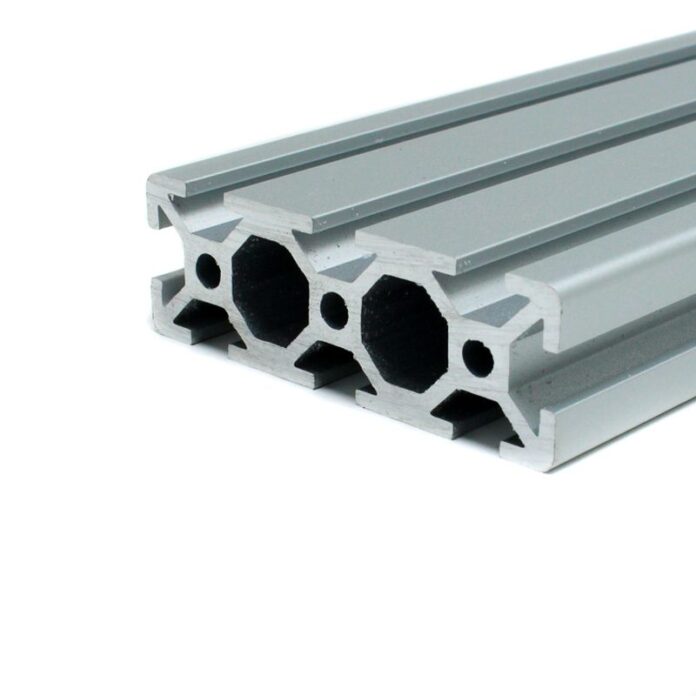

Profile size changes far more than the outside appearance of an aluminum frame. A 30 Series system favors compact, lightweight construction, while a 45 Series system provides a broader range of profiles for larger or more demanding structures. Understanding their differences helps designers avoid excess weight, weak framing, and incompatible hardware.
What Do the Series Numbers Actually Mean?
Series numbers generally describe the basic metric spacing used within each profile family. MiniTec’s 30 Series centers on a 30-millimeter grid, with common options such as 30-by-30 and 30-by-60-millimeter profiles. By comparison, the 45 Series includes profiles based around a larger 45-millimeter format, along with rectangular and specialized shapes for varied industrial structures.
Dimensions influence the profile’s footprint, weight, available internal material, and resistance to bending. Larger sections usually support longer spans or heavier loads with less deflection, although wall thickness and profile geometry also affect performance. Engineers should review technical data rather than assuming that any rail within one series carries the same load.
The 30 Series Keeps Smaller Structures Light
Compact construction is the main strength of the 30 Series. Its reduced dimensions and lower weight suit covers, protective enclosures, lightweight doors, braces, small stands, and space-saving frames. MiniTec identifies this family as a practical option where lighter profiles and a lower-cost system meet the application’s demands.
Limited floor space can also make the smaller format useful. Narrow rails leave more room around instruments, conveyors, tabletop fixtures, or internal machine components. However, a lightweight extruded aluminum T slot profile may need additional bracing if a design includes tall walls, wide openings, or equipment mounted far from the frame.
The 45 Series Handles a Wider Range of Builds
Broader profile choices make the 45 Series suitable for machine guards, workstations, equipment bases, conveyor supports, test fixtures, carts, and larger enclosures. MiniTec lists substantially more 45 Series profiles than 30 Series options, giving designers greater freedom to match the section shape with the load and layout.
Greater size does not automatically mean that the heaviest profile belongs in every position. A frame may use stronger rails along its base while relying on lighter members for doors, panel supports, or overhead accessories. This mixed approach controls material use without weakening the areas that carry significant force.
Strength and Deflection Separate the Two Families
Load capacity depends partly on how much a profile bends across a given span. Since 45 Series members generally offer larger cross-sections, they can provide better stiffness for long rails, mounted equipment, and structures exposed to repeated movement. Exact performance still varies by profile shape, orientation, connection style, and load direction.
Deflection often matters before outright failure becomes a concern. Excessive movement can cause doors to bind, sensors to lose alignment, panels to rattle, or conveyors to run unevenly. Calculations using the published section properties help determine whether lighter MiniTec extruded aluminum framing will remain stable enough for the intended job.
Hardware Compatibility Requires Careful Attention
Components from the two families are not automatically interchangeable. MiniTec notes that 30 Series profiles use special slots that do not accept most 45 Series hardware, and certain 30 Series products are listed for use only with matching fasteners and accessories.
Mixing systems can still be possible through purpose-made transition parts. Certain hinges, for example, allow a 30 Series door to mount on a 45 Series frame. Such combinations work best when designers confirm every bracket, nut, connector, latch, and mounting detail before ordering the aluminum framing kit.
Slot Size Affects Fasteners and Accessories
Each T slot extrusion family uses hardware designed around its channel geometry. Nuts must fit through or slide along the opening, while bolts must match the thread size and bracket thickness. Incorrect parts may feel loose, fail to seat properly, or damage the slot as installers tighten them.
MiniTec’s 45 Series profiles share a common slot design across sections ranging from smaller profiles to much larger structural members. That consistency simplifies accessory selection within the family. Meanwhile, 30 Series hardware remains sized for the more compact system and should be specified separately.
Which Series Fits Guards and Enclosures Better?
Small covers and light-duty barriers often work well with 30 Series aluminum framing material. Slimmer profiles reduce visual bulk and leave larger clear openings for polycarbonate, mesh, or sheet panels. Angled profile options also support sloped faces and multi-sided enclosures without complicated mitered joints.
Taller guards may benefit from 45 Series rails around the outer frame, especially near heavy doors or wide unsupported sections. Designers can sometimes use a stronger 45 Series structure with lighter 30 Series door frames, provided approved transition hardware joins the two systems correctly.
Workspace and Equipment Loads Guide the Decision
Benches carrying hand tools, small fixtures, or inspection devices may not need the larger family. A properly supported 30 Series structure can reduce overall weight and make a mobile station easier to reposition. Short spans and evenly distributed loads further improve its suitability.
Machinery supports require a different review. Motors, actuators, control cabinets, robotic equipment, and cantilevered components may place concentrated forces on a few rails. Under those conditions, T slot aluminum extrusion from the 45 Series often provides more appropriate profile choices and connection options.
Cost Should Be Compared Across the Full Build
Material price represents only one part of the decision. Smaller profiles may cost less and weigh less, yet adding extra braces to compensate for limited stiffness can reduce those savings. Oversized rails, on the other hand, increase cost and mass without improving a lightly loaded structure in a useful way.
Careful selection compares profile price, connector count, assembly labor, expected deflection, future modifications, and shipping weight. MiniTec Aluminum Framing gives builders access to both families, allowing each frame section to match its actual purpose rather than following a single oversized standard.
Matching the Series to the Application
Successful designs begin with load, span, footprint, movement, and accessory requirements. The 30 Series generally fits compact, lightweight assemblies, while the 45 Series suits broader industrial uses and structures needing greater stiffness or larger profile options. Compatibility checks remain essential because the two slot systems use different hardware.
MiniTec Solutions offers both profile families, matching connectors, and application support for businesses planning modular frames. Their product selection can help manufacturers compare MiniTec Aluminum Framing options and choose a system that balances strength, size, weight, adjustability, and long-term use.